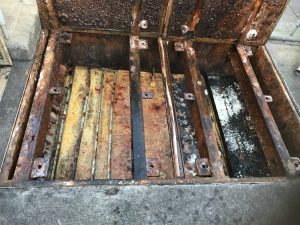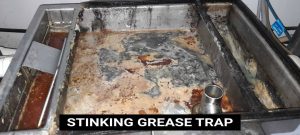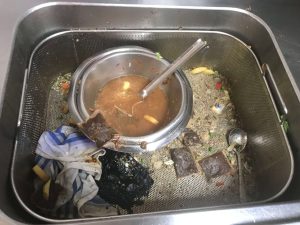


If you run a commercial kitchen, you already know the grease trap is doing more work than it probably should. Most kitchens treat it as the last line of defence, the thing that catches everything the sink didn’t. But here’s the thing – a grease trap was never designed to be a food waste bin. It’s meant to separate fat, oil and grease from wastewater, not deal with rice, bread crusts, vegetable peelings and the odd chip that missed the bin.
When food solids end up in the trap along with the FOG (fat, oil and grease), the whole system has to work harder. And that extra work shows up as cost – in time, in call-outs, and eventually in equipment that wears out faster than it should.
A grease trap’s function is fairly simple in theory. Warm, greasy water flows in from the sink, it cools down inside the trap, and the fat rises to the top while solids settle at the bottom. Cleaner water then flows out to the drain.
That process works well when the water going in is mostly fat, oil, and grease. It doesn’t work nearly as well when there’s a steady stream of food scraps mixed in too. Solids build up faster than expected, the effective capacity of the trap shrinks, and you end up needing services more often than your maintenance schedule accounts for. We’ve covered this in more detail in our guide on how a grease trap works, if you want the fuller picture.
A few things tend to happen, usually all at once:
Blockages become more frequent. Solid food waste doesn’t break down the way grease does. It sits, it compacts, and eventually it narrows the pipework enough to slow drainage or stop it altogether. We go into the common causes in our piece on grease trap blockages, causes and prevention.
Odours get worse, faster. Decomposing food solids mixed with grease create a smell that’s noticeably different (and often stronger) than grease alone. If your kitchen has ever had that unmistakable grease trap smell creep into the dining area, food waste is very often part of the reason. Our guide on identifying and fixing hidden grease trap odour problems covers this well.
Cleaning intervals shrink. A trap that should comfortably run for weeks between services might need attention every few days if it’s absorbing food debris on top of its normal FOG load. That’s more downtime, more disruption during service, and more money spent on call-outs that wouldn’t be necessary otherwise.
Compliance risk goes up. Local authorities and water providers expect grease traps to be maintained properly, and a trap clogged with food solids is far more likely to overflow or discharge poorly, which is exactly the kind of thing that triggers a compliance issue. We wrote about this at length in are you failing grease trap compliance.
It’s worth breaking down where the cost creeps in, because it’s rarely one big expense. It’s a handful of smaller ones that stack up over a year.
None of these costs are dramatic on their own. Together, over a year, they add up to a fair amount – and almost all of it is avoidable.

Stopping food waste at the source is, honestly, one of the cheaper and more straightforward fixes available to a commercial kitchen. It doesn’t need a system overhaul. It mostly comes down to a few habits and a bit of the right equipment.
Sink strainers and baskets. A properly sized strainer at the sink catches solids before they even get near the drain. Ecotec supplies a full range of sink baskets in different sizes to fit standard commercial sink units, plus stainless steel drain strainers for smaller openings. These are genuinely one of the lowest-cost, highest-impact tools a kitchen can add.
Staff habits around scraping plates. Scraping food waste into a bin before plates or pans go anywhere near the sink sounds obvious, but it’s the single biggest factor in how much solid waste ends up downstream. A quick reminder at a shift briefing costs nothing and makes a real difference over a month.
Drain scrapers. For pots and pans with baked-on residue, a tool like our drain saver scraper helps get solids off before rinsing, rather than washing them straight into the system.
Regular checks, not just scheduled services. A quick daily or weekly look at strainers and baskets, just to see what’s being caught, tells you a lot about what’s actually going down the drain. If you’re consistently pulling out food solids, it’s a sign your prep or wash-up process needs a small tweak.
Stopping food waste at the source works best alongside a proper grease trap maintenance routine, not instead of one. Even a trap that never sees a scrap of food still needs regular servicing for the FOG it’s designed to handle. Our grease trap management service covers scheduled cleaning, monitoring and compliance support, so the trap itself is never the weak link.
If you’re not sure how your current setup stacks up, our piece on how a grease management audit can save your business thousands is a good next read. And if odour has already become a noticeable issue in your kitchen, take a look at our hospitality kitchen odour control plan for a structured way to tackle it.

Grease traps are built to handle fat, oil and grease. Ask them to handle food waste too, and you’re shortening their working life while creating problems that show up as odour, blockages, and unplanned costs.
The good news is that the fix doesn’t require new plumbing or an expensive system. A decent strainer, a habit of scraping plates properly, and a bit of attention now and then will keep food waste out of the trap where it doesn’t belong – and keep your maintenance costs closer to what they should actually be.
If you’d like advice on the right strainers, baskets or grease management setup for your kitchen, get in touch with our team and we’ll help you find what fits.